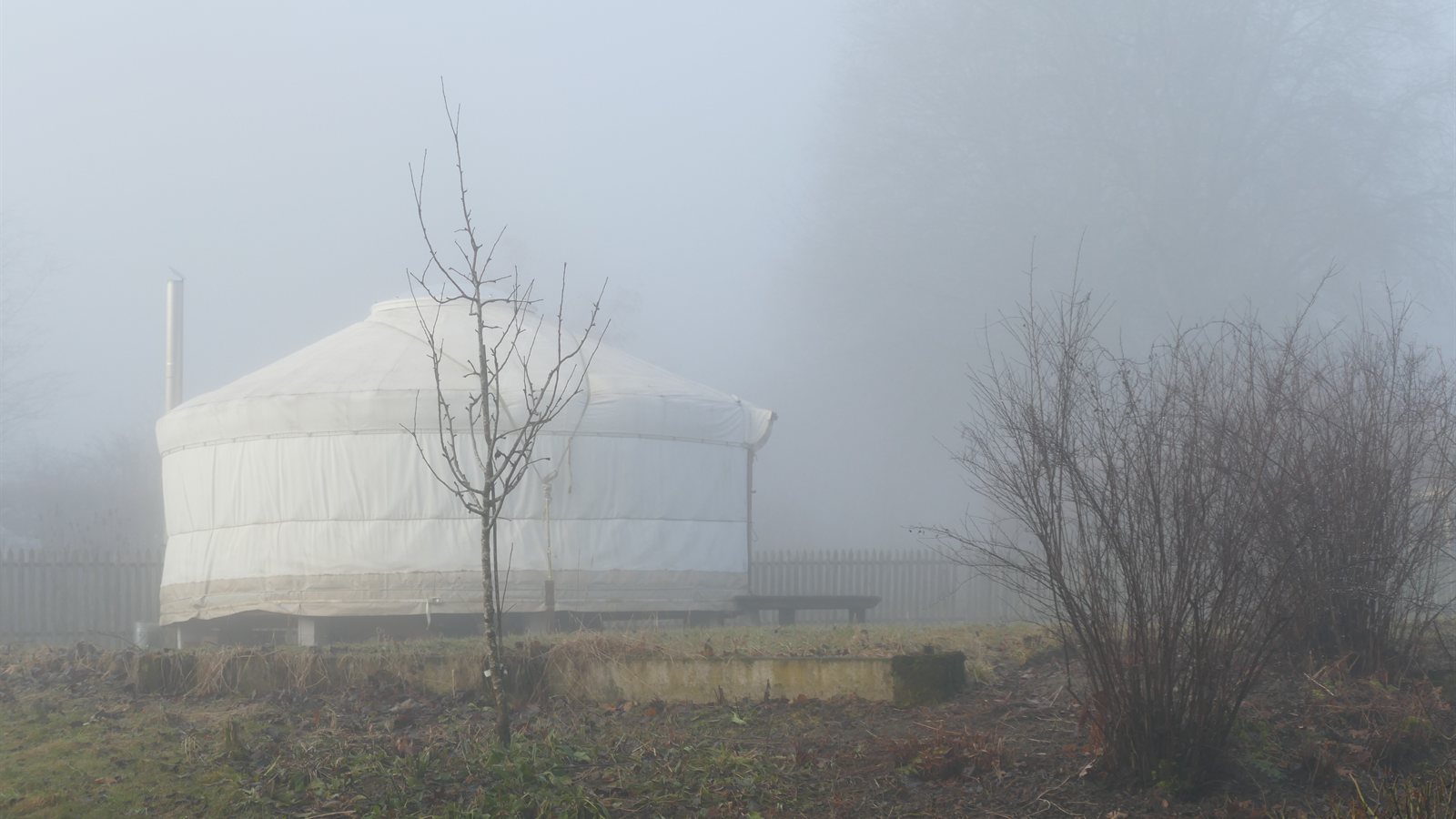
Genuine Distance Between Shelters
Each clearing sits at least two hundred metres from its nearest neighbour, screened by standing woodland and usually separated by the stream itself. That spacing is the reason people sleep here: no car doors, no strangers' conversations, no light spilling across the deck at midnight. Paths are laid so that arriving guests never walk past another shelter, parking is grouped away from the sites, and deliveries stop at a central shed. Even in a full week, the woodland feels empty. Groups who want to be together can book neighbouring clearings, but nobody is placed beside strangers simply to fill the map.
Warm, Dry and Properly Built
Woodland shelters fail in the same predictable ways: cold floors, damp bedding, stoves that smoke and roofs that drum in rain. Ours are insulated under the floor and behind the lining, raised clear of the ground, fitted with flues that draw properly and glazed on the side that catches morning sun. Wool blankets, heavy duvets and hot water bottles are standard, drying racks stand beside every stove, and a dehumidifier runs in the linen store so nothing ever comes out of a cupboard smelling of the forest. Guests arrive to a lit stove and a warm room, whatever the weather is doing outside.
Water You Can Actually Use
The streams are the reason to come, so we make them usable rather than decorative. Two deep pools have been cleared of debris and given stone steps for swimming, a shallow gravel run is safe for small children, and a wood-fired hot tub sits above the bank at one of the larger clearings. Drinking water comes from a tested spring supply piped to every site, and outdoor showers run hot from the same boiler that heats the tub. We monitor water quality monthly, publish the results, and mark the levels at which the pools become unsafe after heavy rain.
Arrival Without Logistics
Nobody wants to start a break by hunting for firewood or driving back out for milk. Every stay begins with the stove lit, the beds made, lanterns charged, a basket of bread, eggs, cheese, coffee and local beer on the table, and a stack of dry wood under cover beside the door. Cast-iron pans, a grill grate, a kettle, a coolbox and a first-aid kit are already in the cabin. A printed map shows the paths, the pools, the nearest bakery and where the phone signal returns. Late arrivals are expected rather than penalised, and the code works from four in the afternoon.
Open Through the Cold Months
Winter is the best season here and the one most operators shut down for. Stoves and insulation are specified for genuine cold, paths are gritted, the wood store is filled before the first frost, and a tractor keeps the access track passable in snow. Shorter days are met with lanterns, a reading shelf in every cabin and a covered fire circle for evenings outside. Frozen edges on the stream, tracks in fresh snow and a forest without a single leaf between you and the sky are worth more than a warm afternoon, and off-season rates make a week affordable.
Low Impact That Is Actually Measured
Claims about sustainability are easy to print, so we publish numbers instead: solar generation and consumption per site, firewood cut from our own coppice rotation, water use, waste separated and composted, and the area replanted each winter. Structures sit on stone pads that can be lifted out, no concrete has been poured on the holding, and detergents supplied in the cabins are certified for use near watercourses. Guests are asked to keep to marked paths in spring, when ground-nesting birds are vulnerable, and each booking contributes to habitat work carried out with a local naturalist group.